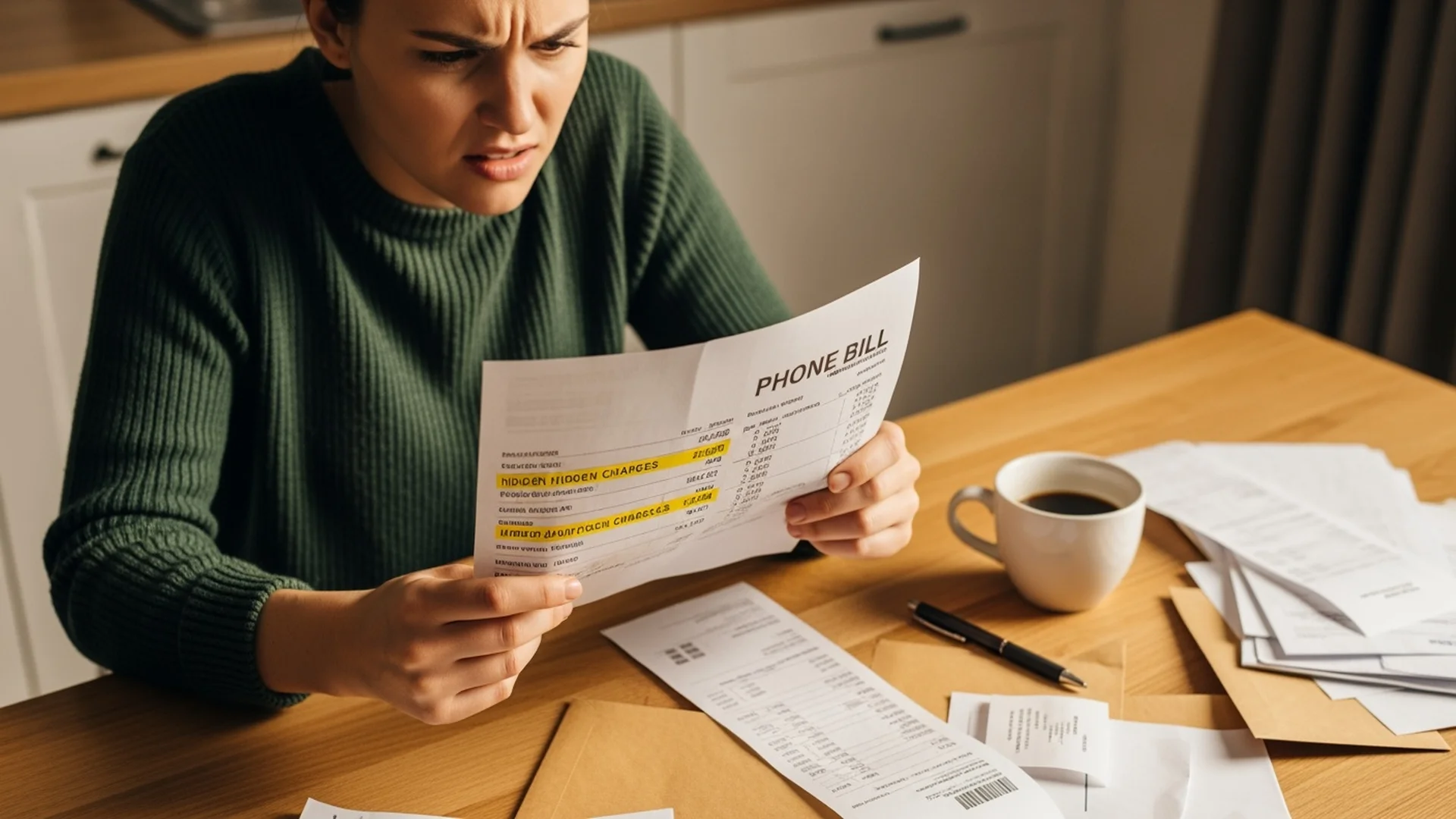
Your $50/mo phone plan costs $2,400 over four years of college. Here's the full breakdown of what you actually pay, what you actually use, and how to save $1,500+ without losing anything.
Somewhere between orientation week and your first midterm, you probably signed up for a phone plan and never thought about it again. Maybe you’re still on your parents’ family plan and Venmo them $40 a month. Maybe you walked into a carrier store near campus and picked whatever the salesperson recommended. Either way, you’re almost certainly paying more than you need to, and over four years of college, that overpayment adds up to a genuinely shocking number.
This isn’t a lecture about cutting back on lattes. This is about a recurring monthly expense where you can get the exact same service for dramatically less money. Same towers, same coverage, same call quality. Just a smaller number on your bank statement every month.
Let’s do the math.
The Four Year Cost Nobody Talks About
When you think about your phone plan, you probably think about the monthly number. Fifty bucks a month. Maybe sixty. It doesn’t feel like much in isolation. But college lasts four years (sometimes five, no judgment), and monthly expenses compound in ways that are easy to ignore.
Here’s what the major carriers actually cost over a full college career:
| Monthly Cost | 1 Year Total | 2 Year Total | 4 Year Total |
|---|---|---|---|
| $50/mo | $600 | $1,200 | $2,400 |
| $65/mo | $780 | $1,560 | $3,120 |
| $80/mo | $960 | $1,920 | $3,840 |
| $100/mo | $1,200 | $2,400 | $4,800 |
If you’re on Verizon’s Welcome Unlimited at $65 a month, you’ll spend $3,120 on phone service before you graduate. If you’re on one of AT&T’s mid tier unlimited plans at $80, that’s $3,840. And if you’re on a premium plan with device payments folded in, you could easily be north of $100 a month, which works out to nearly $5,000 over four years.
For context, that’s more than most students spend on textbooks during their entire college career. It’s a semester of rent in many college towns. It’s a decent used car.
And here’s the part that should bother you: most of what you’re paying for, you aren’t actually using.

You’re Paying for Data You Never Touch
The biggest lie in the phone industry is that everyone needs an unlimited data plan. The carriers have spent billions in advertising to convince you that anything less than unlimited is somehow insufficient. But the reality on a college campus tells a completely different story.
Think about your average day. You wake up in your dorm or apartment, connected to Wi-Fi. You walk to class, maybe using data for a few minutes of music or a podcast. You arrive on campus and connect to the university Wi-Fi. You go to the library, Wi-Fi. You grab coffee, Wi-Fi. You go home, Wi-Fi. You stream Netflix before bed, Wi-Fi.
The only time your phone actually uses cellular data is during those brief windows when you’re walking between buildings, sitting on the bus, or somewhere without a Wi-Fi connection. For most college students, that adds up to somewhere between 2 and 8 GB of actual cellular data per month.
You can verify this right now. It takes about ten seconds.
On iPhone:
- Open Settings
- Tap Cellular
- Scroll down to see “Current Period” data usage
- Each app shows how much cellular data it used
On Android:
- Open Settings
- Tap Network & Internet (or Connections, depending on your phone)
- Tap Data Usage
- Look at your monthly cellular consumption
Go ahead and check. We’ll wait.
If you’re like most students, you’ll find that you’re using somewhere between 3 and 7 GB of cellular data per month while paying for 50 GB or “unlimited.” That gap between what you use and what you pay for is pure profit for your carrier, and pure waste from your wallet.
The Wi-Fi Reality on College Campuses
Modern college campuses are blanketed in Wi-Fi. The academic buildings, the student union, the dining halls, the recreation center, the outdoor common areas, almost everywhere you spend time on campus has a Wi-Fi connection. Most universities have invested heavily in their wireless infrastructure over the past decade, and the coverage is typically excellent.
Your off campus life is similarly Wi-Fi heavy. Your apartment has Wi-Fi. The coffee shops where you study have Wi-Fi. The public library has Wi-Fi. Restaurants have Wi-Fi. Even many buses and public transit systems now offer Wi-Fi.
When your phone connects to Wi-Fi, it stops using cellular data entirely. Every YouTube video, every Instagram scroll, every Spotify stream, every FaceTime call on Wi-Fi costs you zero cellular data. The “unlimited” plan you’re paying $65 a month for is doing almost nothing that a $15 or $25 plan couldn’t do.
The Hidden Costs They Don’t Advertise
The sticker price on your phone plan isn’t the whole story. There are several costs that carriers either bury in fine print or structure in ways that are deliberately hard to see.
Activation Fees
Most major carriers charge an activation fee when you start a new line. This is typically $30 to $35 per line. Some waive it during promotions, but many students end up paying it without even realizing it was added to their first bill.
Line Access Fees
On family plans, each line often carries a “line access fee” of $20 to $40 per month on top of the plan cost. When your parents tell you the family plan is $35 per line, they may not be accounting for the line access charge that shows up separately on the bill.
Phone Financing Built Into Plan Pricing
This is the sneakiest one. Many carriers have raised their plan prices over the past few years specifically because they bundle device financing into the cost structure. The “new phone every year” pitch sounds great until you realize you’re paying for it through inflated monthly rates, even if you brought your own phone and don’t owe anything on a device.
Some carriers offer a discount if you bring your own device, but it’s usually only $5 to $10 off. The rest of that built in phone subsidy stays in your bill as pure profit for the carrier.
Regulatory and Administrative Fees
These vary by carrier and location, but they typically add $3 to $8 per month to your bill. They’re not government taxes (though they’re designed to look like them). They’re carrier charges that pad the bottom line while keeping the advertised price artificially low. We break down every one of these charges in our guide to hidden fees on your phone bill.
The Real Monthly Cost
When you add up the base plan, line access fees, regulatory fees, and the amortized activation cost, a plan advertised at $50 often actually costs $58 to $68 per month. A plan advertised at $65 can run $75 to $85 in practice.
Over four years, those hidden costs add $400 to $800 on top of what you thought you were paying.
The “Same Towers” Argument (It’s True)
Here’s something the major carriers would prefer you didn’t know: smaller carriers and MVNOs (Mobile Virtual Network Operators) use the exact same cell towers as Verizon, T-Mobile, and AT&T. When you pay $65 a month for Verizon, your phone connects to a Verizon tower. When you pay $25 a month for a carrier that partners with Verizon’s network, your phone connects to the same Verizon tower.
Same tower. Same signal. Same coverage map. Different price.
This isn’t some obscure loophole. It’s how the phone industry has worked for over a decade. The FCC requires network operators to lease tower access to other carriers, and many carriers have built their entire business model around using these partnerships to offer lower prices.
World Mobile takes this a step further by partnering with four major US network providers simultaneously. Your phone automatically connects to whichever partner network has the strongest signal in your location. In most areas, that means you’re effectively getting access to T-Mobile, Verizon, and AT&T coverage all at once, for a fraction of what any single one of them charges.
The coverage isn’t almost as good. It isn’t pretty close. It’s the same infrastructure. The calls travel through the same towers, the data passes through the same networks, and your phone doesn’t know or care which brand name is on the monthly bill.
But What About Priority?
The one legitimate technical difference is network priority. During periods of extreme congestion (think a packed football stadium during a game or a major event downtown), carriers that own the network may get priority over carriers that lease it. In practice, for college students, this almost never matters. Campus congestion is handled by the university’s Wi-Fi network, not the cellular towers. And in everyday use around town, network congestion sufficient to cause noticeable slowdowns is rare.
If you’re paying an extra $30 to $40 per month for “priority” that makes a perceptible difference maybe a handful of minutes per year, that’s not a good deal.
What the Numbers Actually Look Like: World Mobile vs. Everyone Else
Let’s lay out a direct comparison. These are individual line prices for the most comparable plans across carriers.
Budget Tier (Light Data Users)
| Carrier | Plan | Data | Monthly Cost | Annual Cost | 4 Year Cost |
|---|---|---|---|---|---|
| World Mobile | Starter | 2 GB | $15 | $180 | $720 |
| T-Mobile | Essentials | Unlimited* | $50 | $600 | $2,400 |
| Verizon | Welcome Unlimited | Unlimited* | $65 | $780 | $3,120 |
| AT&T | Unlimited Starter | Unlimited* | $65 | $780 | $3,120 |
*“Unlimited” on these plans means deprioritized data, which means speeds drop when the network is busy. For light users who mainly need 2 to 8 GB, this unlimited label is marketing, not a real benefit.
Mid Tier (Typical Student Usage)
| Carrier | Plan | Data | Monthly Cost | Annual Cost | 4 Year Cost |
|---|---|---|---|---|---|
| World Mobile | Standard | 8 GB | $25 | $300 | $1,200 |
| World Mobile | Unlimited | 25 GB | $40 | $480 | $1,920 |
| T-Mobile | Go5G | Unlimited | $75 | $900 | $3,600 |
| Verizon | Unlimited Plus | Unlimited | $80 | $960 | $3,840 |
| AT&T | Unlimited Extra | Unlimited | $75 | $900 | $3,600 |
Feature Comparison
Not all plans are created equal beyond just price and data. Here’s what you actually get:
| Feature | World Mobile (all plans) | Verizon Welcome | T-Mobile Essentials | AT&T Starter |
|---|---|---|---|---|
| Unlimited Calls & Texts | Yes | Yes | Yes | Yes |
| Built in VPN | Yes (free) | No ($) | No ($5/mo add on) | No |
| eSIM Activation | Yes | Yes | Yes | Yes |
| Mobile Hotspot | Yes (all plans) | No | No | No |
| Contract Required | No | No* | No* | No* |
| Identity Protection | Yes (Unlimited+) | No | No | No |
| International Calls | Yes (Unlimited+) | No ($10/mo add on) | No ($15/mo add on) | No ($10/mo add on) |
| 50% Off First Month | Yes | No | No | No |
*While major carriers technically don’t require contracts, device payment plans effectively lock you in for 24 to 36 months. If you leave before the phone is paid off, the remaining balance is due immediately.
The VPN alone is worth noting. A standalone VPN service costs $5 to $12 per month. If you’re paying for one separately (and you should be using one, especially on campus Wi-Fi), that’s an additional $60 to $144 per year that World Mobile includes for free. For the complete feature-by-feature breakdown across all carriers, see our side-by-side carrier comparison.

The Four Year Savings: Made Tangible
Let’s calculate the actual savings for a student who switches from a typical major carrier plan to World Mobile.
Scenario 1: Verizon to World Mobile Standard
- Current cost: $65/mo (Verizon Welcome Unlimited)
- New cost: $25/mo (World Mobile Standard, 8 GB)
- Monthly savings: $40
- Annual savings: $480
- Four year savings: $1,920
Scenario 2: T-Mobile to World Mobile Starter
- Current cost: $50/mo (T-Mobile Essentials)
- New cost: $15/mo (World Mobile Starter, 2 GB)
- Monthly savings: $35
- Annual savings: $420
- Four year savings: $1,680
Scenario 3: AT&T to World Mobile Unlimited
- Current cost: $75/mo (AT&T Unlimited Extra)
- New cost: $40/mo (World Mobile Unlimited, 25 GB)
- Monthly savings: $35
- Annual savings: $420
- Four year savings: $1,680
Even in the most conservative scenario, you’re saving over $1,600 during college. In the most common scenario (switching from Verizon to World Mobile Standard), you’re saving nearly $2,000.
What $1,920 Actually Buys
Numbers in a spreadsheet are easy to ignore. Let’s make the savings tangible:
- Textbooks for your entire degree (or close to it, depending on your major)
- A round trip flight to Europe and spending money when you get there
- 8 months of groceries at a typical student budget
- A semester of rent in many college towns
- A quality used laptop that lasts through graduation
- 48 weeks of eating out once a week at $40 per meal
- A solid emergency fund to start your post graduation life
- 192 large coffees from your campus cafe
- Two music festival tickets with money left for gas and food
- A professional wardrobe for job interviews and your first job
- The entirety of a spring break trip including flights and accommodation
The point isn’t that you need to be frugal about everything. It’s that your phone plan is money leaving your account every month for no added benefit. When you can redirect that money toward things that actually improve your life, there’s no reason not to.
Family Plan Math: Why Splitting Off Might Save You Money
If you’re on a family plan with your parents, the conventional wisdom is that family plans are always cheaper per line. That used to be true. It’s increasingly not.
How Family Plans Actually Work
On most major carriers, a family plan has a base cost plus a per line fee. Here’s how it typically breaks down:
| Carrier | 1 Line | 2 Lines | 3 Lines | 4 Lines | Per Line (4) |
|---|---|---|---|---|---|
| T-Mobile Go5G | $75 | $130 | $165 | $200 | $50 |
| Verizon Welcome | $65 | $120 | $155 | $180 | $45 |
| AT&T Starter | $65 | $120 | $150 | $180 | $45 |
| World Mobile Unlimited | $40 | $72 | $96 | $112 | $28 |
At first glance, $45 per line on a Verizon family plan seems cheaper than $65 for a standalone Verizon plan. And it is. But compare that $45 per line to World Mobile’s options:
- World Mobile Starter: $15/mo standalone
- World Mobile Standard: $25/mo standalone
- World Mobile Unlimited (4 lines): $28/mo per line
Your share of the family Verizon plan at $45 per line is still almost double what you’d pay on World Mobile Standard at $25, and still more expensive than World Mobile Unlimited with the family discount at $28.
World Mobile Family Discounts
World Mobile offers automatic discounts when you add multiple lines:
- 2 lines: 10% off each line
- 3 lines: 20% off each line
- 4+ lines: 30% off each line
This means a family of four on World Mobile Unlimited ($40 base price) pays $28 per line, or $112 total for the family. Compare that to $180 on Verizon or $200 on T-Mobile for comparable coverage.
The Independence Factor
Beyond the pure math, there’s a practical argument for getting your own plan. Being on a family plan means your parents can see your data usage. It means you’re dependent on someone else to manage the account. It means any changes to the family plan affect everyone, and removing yourself later can change pricing for the remaining lines.
At $15 or $25 a month, having your own standalone phone plan costs less than your share of most family plans on major carriers. You get independence, you get a simpler bill, and you don’t have to coordinate with anyone when you want to make changes.
The Conversation With Your Parents
If you’re thinking about splitting off from a family plan, here’s the practical approach. Check the family plan bill and figure out exactly how much your line costs (remember to include line access fees and your share of any device payments). Then compare that to what you’d pay on World Mobile. In most cases, your new standalone plan will be cheaper than your line on the family plan.
If your parents are paying for your phone service, show them the comparison. Many families end up switching the entire family to World Mobile once they see the savings. A family of four moving from Verizon to World Mobile saves roughly $800 per year. That’s enough to notice.
All World Mobile Plans at a Glance
Here’s the full lineup with every detail that matters:
| Starter | Standard | Unlimited | Unlimited+ | |
|---|---|---|---|---|
| Monthly Price | $15 | $25 | $40 | $55 |
| High Speed Data | 2 GB | 8 GB | 25 GB | 50 GB |
| Hotspot | From data allotment | From data allotment | 15 GB dedicated | 15 GB dedicated |
| Unlimited Calls & Texts | Yes | Yes | Yes | Yes |
| Built in VPN | Yes | Yes | Yes | Yes |
| eSIM | Yes | Yes | Yes | Yes |
| Identity Protection | No | No | Yes | Yes ($1M coverage) |
| SIM Swap Protection | No | No | No | Yes |
| International Calls | No | No | Yes (60 countries) | Yes (60 countries) |
| Contract | None | None | None | None |
| First Month | $7.50 (50% off) | $12.50 (50% off) | $20 (50% off) | $27.50 (50% off) |
| Best For | Heavy Wi-Fi users | Most students | Streamers, heavy users | Power users, travelers |
For the typical college student who’s on campus Wi-Fi most of the day, the Standard plan at $25/month covers everything. If you barely use data away from Wi-Fi, the Starter at $15/month is the cheapest quality phone service you can get. If you stream a lot on cellular or need hotspot for your laptop, the Unlimited at $40/month is still cheaper than every major carrier’s base plan.
New subscribers get 50% off their first month on any plan. No promo codes, no hoops. It’s automatic.
How to Actually Switch (It Takes Five Minutes)
Switching phone carriers sounds like it should be complicated. It isn’t. The entire process is online and takes less time than ordering food delivery.
Step 1: Check Your Actual Data Usage
Before choosing a plan, check how much cellular data you actually use. Follow the instructions from earlier in this post (Settings, Cellular on iPhone; Settings, Network, Data Usage on Android). Look at the last three months to get a realistic average.
If you consistently use less than 2 GB: Starter ($15/mo). If you use 2 to 8 GB: Standard ($25/mo). If you use 8 to 25 GB: Unlimited ($40/mo). If you use 25+ GB or need dedicated hotspot: Unlimited+ ($55/mo).
Step 2: Make Sure Your Phone Is Unlocked
If you bought your phone outright or finished paying it off, it’s unlocked. If you’re unsure, you can check in your phone’s settings or call your current carrier. If you still owe money on the phone, you’ll need to pay off the remaining balance before switching (this is a carrier lock, not a technical limitation).
Step 3: Sign Up Online
Go to hexymobile.com and choose your plan. During signup, you’ll have the option to keep your current phone number (called porting) or get a new number. Most people port their existing number.
You can also sign up directly through World Mobile to get started.
Step 4: Activate Your eSIM
After signing up, you’ll receive a QR code. Open your phone’s camera, point it at the code, and follow the prompts to install the eSIM. No store visit, no waiting for a SIM card in the mail.
If your phone doesn’t support eSIM (most phones from 2019 onward do), World Mobile also offers physical SIM cards.
Step 5: You’re Done
Your phone connects to the network within minutes. If you ported your number, the transfer typically completes within a few minutes to a few hours. Your old carrier’s service stays active during the transition so you don’t miss anything.
When the port completes, your old service is automatically cancelled. You don’t need to call your previous carrier.
What About Coverage?
This is the first question everyone asks, and the answer is straightforward. World Mobile partners with four major US network providers. In any given location, your phone connects to whichever partner network has the strongest signal. This means you’re using the same towers and infrastructure as T-Mobile, AT&T, and Verizon subscribers.
Coverage works across 99% of the US. Whether you’re on campus, driving home for the holidays, road tripping over spring break, or moving to a new city after graduation, your plan works the same everywhere.
For students in the Pacific Northwest specifically, we’ve covered Bellingham area coverage in detail in our guide to affordable phone plans in Bellingham. Coverage across the region is strong, including campus areas, downtown, suburban neighborhoods, and the major highways. Students at UW Seattle, UO Eugene, Portland State, and other PNW schools can find campus-specific guides on our student plans hub.
Real Student Scenarios
The Freshman on a Tight Budget
You just moved into the dorms. Every dollar counts. You’re on campus Wi-Fi all day and your apartment has Wi-Fi at night. You mainly use your phone for calls, texts, social media, and the occasional Google Maps search when you’re lost looking for a building.
Your actual data usage: 1 to 3 GB per month Best plan: World Mobile Starter at $15/month Annual cost: $180 Four year cost: $720 Savings vs. Verizon ($65/mo): $2,400 over four years
That $2,400 is enough to fund your textbooks for nearly your entire degree.
The Average Student
You use your phone normally. Social media, music on your commute, messaging, video calls with family, some browsing between classes. You’re on Wi-Fi most of the time but use a fair amount of data when you’re out and about.
Your actual data usage: 4 to 8 GB per month Best plan: World Mobile Standard at $25/month Annual cost: $300 Four year cost: $1,200 Savings vs. T-Mobile ($50/mo): $1,200 over four years
That’s a round trip flight to Europe, or a solid emergency fund, or two months of rent.
The Off Campus Streamer
You live off campus, commute to class, and stream music, podcasts, and videos throughout the day. You sometimes use your phone as a hotspot when your apartment Wi-Fi is unreliable. You’re a heavier data user than most.
Your actual data usage: 10 to 20 GB per month Best plan: World Mobile Unlimited at $40/month Annual cost: $480 Four year cost: $1,920 Savings vs. AT&T ($75/mo): $1,680 over four years
Even as a heavy user, you’re still saving over $1,600 during college. And you’re getting 15 GB of dedicated hotspot data, a VPN, and identity protection included.
The International Student
You’re studying in the US but need to stay connected with family abroad. International calling add ons from major carriers run $10 to $15 per month, and they often cover fewer countries than you’d expect.
Best plan: World Mobile Unlimited at $40/month What you get: International calling to 60 countries included at no extra charge, plus a built in VPN that’s useful for accessing content from your home country.
On a major carrier, you’d pay $65 to $80 for the base plan plus $10 to $15 for international calling, totaling $75 to $95 per month. World Mobile Unlimited at $40 covers everything.
Four year savings: $1,680 to $2,640
The Opportunity Cost of Overpaying
Economics students will recognize this concept. The money you spend on an overpriced phone plan isn’t just gone; it’s money you could have spent on something else. That’s the opportunity cost.
Let’s say you’re currently paying $65 a month and you switch to $25 a month. That’s $40 per month in savings, or $480 per year. Here are some things that $480 per year could become:
If you invested it: $480 per year invested at a 7% annual return (the historical stock market average) grows to approximately $2,200 by the time you graduate. If you keep investing that $480 per year for ten years after college, it grows to roughly $7,500. That’s the power of starting early.
If you put it toward student loans: An extra $480 per year applied to student loan principal reduces your total interest paid and shortens your repayment timeline. On a $30,000 loan at 5% interest, an extra $480 per year saves you approximately $1,200 in total interest and pays off the loan nearly two years early.
If you saved it for emergencies: After four years, you’d have $1,920 in an emergency fund. Financial advisors recommend having three to six months of expenses saved. For a college student, $1,920 is a meaningful cushion against unexpected car repairs, medical bills, or the gap between graduation and your first paycheck.
The money you’re sending to Verizon or AT&T each month could be building your financial future instead. The phone service would be identical either way. The only question is whether you’d rather that money sit in a carrier’s revenue report or in your own bank account.
Common Objections (And Why They Don’t Hold Up)
“But I’ve always had Verizon/T-Mobile/AT&T”
Brand loyalty to a phone carrier is like brand loyalty to your electric company. They provide a utility. The electricity coming through the wall is the same regardless of which company bills you for it. The signal coming through your phone is the same regardless of which carrier bills you for it (when they use the same towers, which they do).
”What if the coverage is worse?”
The coverage is not worse. It’s the same towers. If you can currently make a call from your dorm room on Verizon, you can make the same call from the same spot on a carrier that uses Verizon’s network. The radio waves don’t check which company is billing you before deciding whether to connect.
”Unlimited data gives me peace of mind”
Check your usage. If you’re using 5 GB a month and paying for unlimited, you’re paying for peace of mind that costs $300+ per year. An 8 GB plan would give you the same peace of mind with a 60% buffer above your actual usage, at less than half the price.
”Switching sounds like a hassle”
It’s a five minute process done entirely on your phone. You scan a QR code and you’re done. It’s less effort than setting up a new social media account. Our eSIM setup guide walks through every step, and our number porting guide covers how to keep your phone number during the switch.
”My parents handle the bill so I don’t care”
Your parents are overpaying too. Show them this article. A family of four switching from Verizon to World Mobile saves roughly $800 per year. Parents notice $800.
Frequently Asked Questions
Is $15 a month too cheap to be a real phone plan?
No. The $15 Starter plan includes unlimited calls, unlimited texts, 2 GB of high speed data, a built in VPN, mobile hotspot, and eSIM activation. It uses the same cell towers as T-Mobile, Verizon, and AT&T. The lower price comes from a different business model with lower overhead, not from cutting corners on service quality. For students who are on Wi-Fi most of the day, 2 GB of cellular data is more than enough.
Will I lose my phone number if I switch?
No. During signup, you can port (transfer) your existing phone number to World Mobile. The transfer typically completes within minutes. Your old carrier’s service stays active during the transition so you won’t miss any calls or texts. Once the port completes, your old service is automatically cancelled.
What happens if I use all my high speed data before the month ends?
Your service doesn’t stop. Your data speeds are reduced for the remainder of the billing cycle, but you can still make calls, send texts, browse the web, and use apps. Speeds reset at the start of your next billing cycle. If you find yourself consistently running out of high speed data, you can upgrade to the next plan tier at any time since there are no contracts.
Can I use my phone as a Wi-Fi hotspot for my laptop?
Yes, every World Mobile plan includes mobile hotspot at no extra charge. On the Starter and Standard plans, hotspot data comes from your high speed data allotment. On the Unlimited and Unlimited+ plans, you get 15 GB of dedicated hotspot data per month, separate from your phone’s data. This is great for studying in places where Wi-Fi is slow or unavailable.
Do I need to buy a new phone?
Almost certainly not. Any unlocked phone with eSIM support works, and that includes most phones manufactured after 2019. All iPhones from the XR onward, Samsung Galaxy S20 and newer, Google Pixel 3 and newer, and many other Android devices support eSIM. If your phone doesn’t support eSIM, World Mobile offers physical SIM cards as well.
What if I study abroad for a semester?
Since there are no contracts, you can cancel your plan before you leave and sign up again when you return. No termination fees, no reactivation fees, no penalties. You can also keep your plan active to maintain your phone number while abroad. The flexibility is one of the biggest advantages of a no contract plan for students.
How do I split off from my family plan?
Sign up for your own World Mobile plan and port your number. When your number transfers to World Mobile, your line is automatically removed from the family plan. The other lines on the family plan stay active. Give your family a heads up before you switch, since removing a line can sometimes change the per line pricing for the remaining members. At $15 to $25 per month standalone, your own plan is likely cheaper than your share of the family plan.
Is there a student discount?
World Mobile’s plans are already priced below what most carriers charge after student discounts. The Starter plan at $15 per month and Standard plan at $25 per month are cheaper than any major carrier’s student pricing. All new subscribers also get 50% off their first month automatically, which brings the Starter plan down to $7.50 and the Standard to $12.50 for month one.
What's the catch?
There isn’t one in the traditional sense. You get the same coverage (same towers), the same call quality, and features like a VPN and hotspot that many carriers charge extra for. The trade off, if you want to call it that, is that World Mobile is a newer brand without decades of name recognition. But the network infrastructure you’re connecting to is the same infrastructure that’s been serving major carrier subscribers for years.
Can I refer friends and earn money?
Yes. World Mobile runs a Refer & Earn program where you can earn up to $45 for each person you refer. Your friend gets 50% off their first month, and you earn rewards at multiple milestones as they remain a subscriber. We’ve written a complete guide to the referral program with the full breakdown of earnings by plan and billing cycle.
The Bottom Line
Your phone plan is probably the easiest place in your budget to save real money without changing anything about how you live. You don’t eat less. You don’t go out less. You don’t sacrifice quality. You just pay less for the same service.
The math is simple:
- Starter ($15/mo): $720 over four years of college
- Standard ($25/mo): $1,200 over four years of college
- Typical major carrier ($65/mo): $3,120 over four years of college
That’s a difference of $1,920. Nearly two thousand dollars. For the same towers, the same coverage, and the same calls.
Check your data usage. Compare it to what you’re paying for. Then decide whether you’d rather send that money to a carrier that doesn’t need it, or keep it for yourself.
The switch takes five minutes. The savings last four years. And your first month is 50% off.
Get started at hexymobile.com or sign up directly through World Mobile.
For more on affordable phone plans and campus specific guides, check out our WWU student phone plan comparison and our Bellingham phone plan guide.
Ready to switch? Plans start at $15/mo.
Sign Up at HexyMobileStay in the Loop
Phone plan tips, coverage updates, and deals for the PNW. No spam.